Friday, 14 June 2024

Kinetic Energy : Solve these problems


1. What is the Kinetic Energy of a 150 kg object that is moving with a speed of 15 m/s? 

2. An object has a kinetic energy of 25 J and a mass of 34 kg , how fast is the object moving? 

3. An object moving with a speed of 35 m/s and has a kinetic energy of 1500 J, what is the mass of the object.

 4. What is the Kinetic Energy of a 1200 kg object that is moving with a speed of 24 m/s? 

5. An object has a kinetic energy of 14 J and a mass of 17 kg , how fast is the object moving? 

6. An object moving with a speed of 67 m/s and has a kinetic energy of 500 J, what is the mass of the object. 

7. What is the Kinetic Energy of a 478 kg object that is moving with a speed of 15 m/s? 

8. An object has a kinetic energy of 88 J and a mass of 45 kg , how fast is the object moving? 9. An object moving with a speed of 21 m/s and has a kinetic energy of 140 J, what is the mass of the object. 

10. What is the Kinetic Energy of a 100 kg object that is moving with a speed of 12.5 m/s?

Monday, 13 May 2024

Introduction to Radioactivity

 Here are the Fusion and Fission notes 

I gave you a worksheet called 7.3 Nuclear Reactions, the answer key to that is here
There is also the Radioactive unit exam study guide  and Answer key 

Wednesday, 1 May 2024

X-linked genes

 SEX LINKED GENES

In the following post, I will refer to the term  "male" and "female".  This refers to people with male sex organs or people with female sex organs.  People with these organs can identify with a diverse range of gender such as:

Man, woman, nonbinary. This gender identify is not presumed by the presence of male or female sex organs

They might also identify as
LGBTQ2S++

The following descriptions are biological descriptions refer to 
male= has male sex organs like testes, producing male gametes such as sperm
female= has female sex organs like ovaries, producing female gametes such as  eggs. 


The sex chromosomes are XX and XY in humans. Some alleles are located on the X chromosome. But very few on the Y chromosome.  Remember that people who are  females have the genotype XX and people who are males have XY.

The Y chromosome carries very little information, only enough to influence the embryo on the path towards male primary and secondary characteristics.

Meanwhile, many RECESSIVE ALLELES are located on the X chromosome, including
1. hemophilia, the inability to clot blood
2. colourblindness inability to tell the difference between red and green colour
3.  baldness

These characteristics are far more common in people with male sex organs  than people with female sex organs because  people with male organs have only one X. And if that X contains the recessive allele, they will show the phenotype.  Meanwhile,people with  female organs may have the recessive and their dominant genes on their other X will protect them.  For example
An example of using a punnet square to calculate probability is here:


Some things to note about sex linkage:  Signs of sex linked alleles are:
1. more genotypic males get the phenotype, but genotypic females can be carriers
2.  males can inherit from mother but not father (because males get their X from mom)
3.  genotypic females have an extra X and this protects them.  Females must be homozygous to show the sex linked phenotype.
Further reading on sex linkage here http://learn.genetics.utah.edu/content/pigeons/sexlinkage/


FYI if you were born a male and you want to know if you're colourblind:  Test yourself here: But careful, if you are a genetically male, you might find out you are colour blind!  Apparently most people find out they are colourblind from their science teacher !  
http://colorvisiontesting.com/home.html


Basic practice worksheet going over main concepts

Thursday, 14 March 2024

Monday, 11 March 2024

Chemistry Karate Practice!

 This is the  Chemistry practice sheet Here is the Chemistry practice sheet key.


Do the work on this practice sheet on your own piece of paper up to page 11.  If you finish, you can continue your practice.   Take breaks as you need to! This is hard work!
 10 marks for completing this. 

later,  is an activity next week called " Chemistry Karate"  where your chemistry skills will be respectfully assessed by myself and by peers and you will demonstrate your level of chemistry karate belt.  The goal is to move up one belt, not for everyone to be a black belt ! 


Tuesday, 5 March 2024

TYPES OF REACTIONS

TEACHING NOTES: First lets review the main types of reactions: 

notes on types of reactions

Study Guide  and answer key below

 answer key to your chapter 6 worksheet

LESSON: Chemical reactions may be categorized as follows : 

1.     Synthesis
2.     Decomposition
3.     Single replacement
4.     Double replacement

5.     Combustion
       Cellular Respiration
6.     Oxidation of metals


Synthesis reaction:
element     +   element    -->    compound


Decomposition reaction:
Compound    -->   element     +     element
Or

Compound --> smaller compound    +   element


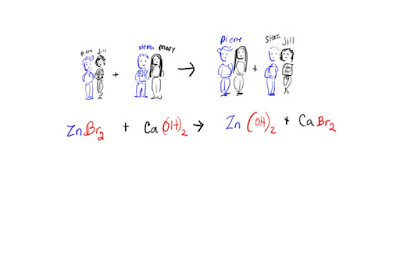
DOUBLE REPLACEMENT


single replacement
IN ADDITION TO THE FOUR TYPES ABOVE, THERE ARE ALSO THREE MORE KINDS of reaction TO KNOW: 

Combustion:  combustion may happen to any *organic compound* meaning any compound made of carbon, hydrogen and/or oxygen...
Carbon based compound+ oxygen --> carbon dioxide + water
+ heat and light energy


Cell respiration looks like combustion,
BUT IT IS NOT. YOUR CELLS ARE NOT COMBUSTING.  The carbon based compound in this case is glucose, a simple sugar.

Glucose +   oxygen -->  carbon dioxide + water + energy for cell


Oxidation reaction

Metal +  oxygen   -->   metal oxide

ACID BASE REACTIONS ARE ALL NEUTRALIZATION REACTIONS


In summary....


 answer key to your chapter 6 worksheet


Friday, 1 March 2024

Calcium lab report


Lab Jounral assignment includes the following labs:

Assignment:   Write up our lab on Calcium and water. FORMAT:  paper write up or word doc or pdf or powerpoint 

image by Katelyn M

 Your lab must include the following

1.  Your First and Last name 

2. Purpose of lab:  The purpose of the lab is to find out what happens when you add calcium to water. PART I  Describe the teacher demo that preceded this lab. 

PART II DESCRIBE THE STUDENT EXPERIMENT IN DETAIL 
3.a Materials: write a complete list of materials that we used 
b.  Safety:  list the safety precautions for this lab

4. Procedure: Draw a cartoon to describe the step by step procedure  that is so well written that another person could read it and replicate your actions exactly. You may also upload pics demonstrating your procedure. 
A. PROCEDURE WITH TEST TUBE AND BEAKER
B  PROCEDURE WITH BEAKER AND SOAP

5.  What is the question we are trying to answer?  For example there were two possible gases that came out of this reaction.  What gases were they? What are the three BALANCED EQUATIONS that were possible outcomes of this lab?

6. Results:  Describe in detail what happened after you did the procedure.  Include any photos you took.  How did you know you made the gas, which gas?  

7.  What was the white stuff?  How did you test for the identity of the white stuff? 

8. Write your conclusion in paragraph form.  


EVALUATION   IS OUT OF 25 IN TOTAL

5
presentation is out of 5.  for 5/5 it is typed  with illustrations or photos and handed in electronically or on paper
     for 4/5 it is pretty good but there are a few spelling mistakes.  for 0-3 out of 5 it is in pencil or messy.  I prefer this to be printed

10
Clear writing is out of 10.  for 9/10 or 10/10, it is written with no English mistakes and it clearly communicates each part of the lab report.    7-8/10  it is very well written     for 5-6/10 some parts are not so clear and the reader must guess what you are trying to say.  0-4/10, it is minimally communicating what happened

10
Paragraphs are insightful and your observations are well done. this is out of 10.
             9-10/10,   your observations and conclusions are well written and logical.  It is brilliant
              7-8/10   your observations and conclusions are very well done
               5-6   your conclusions don't really logically follow from your results
                0-4   your conclusions are not relating to your results at all