Thursday, 12 October 2017

balancing lego equations, practice sheets and types of reactions

We practiced balancing equations using lego. make sure you finish this and hand it in to  msngscience@gmail.com

IF you are finished, practice your chemistry:

Recall that worksheet  Chemistry practice sheet and the  Chemistry practice sheet key. This was given for homework and you will be tested on this soon.

if you are done that, then there is another worksheet on types of reactions:
worksheet. Here is the answer key for types of reactions

Tuesday, 10 October 2017

The Law of Conservation of Mass


send to msngscience@gmail.com

Calcium and Water lab write up

We did notes on the Law of Conservation of Mass and we did a lab.  This is the criteria for the lab write up


Your lab must include the following

1.  First and Last names of all investigators
2. Purpose of lab:  write about how this lab illustrates the law of conservation of mass.  Explain how the lab relates to the law
3. Materials: write a complete list of materials that we used
4. Procedure: write a step by step procedure (including illustrations if it makes it clearer) that is so well written that another person could read it and replicate your actions exactly
5.  What is the question we are trying to answer?  Write the two chemistry equations which were our possible outcomes of this reaction?  Oxygen gas or Hydrogen gas?
6. Results:  Describe in detail what happened after you did the procedure.  Include any photos you took.  How did you know you made the gas, which gas?  And was it Calcium hydroxide that was made? How do you know?

7.  Write your conclusion in paragraph form.


EVALUATION   IS OUT OF 25 IN TOTAL

5
presentation is out of 5.  for 5/5 it is typed  with illustrations or photos and emailed to msngscience@gmail.com.     for 4/5 it is pretty good but there are a few spelling mistakes.  for 0-3 out of 5 it is in pencil or messy

10
Clear writing is out of 10.  for 9/10 or 10/10, it is written with no English mistakes and it clearly communicates each part of the lab report.    7-8/10  it is very well written     for 5-6/10 some parts are not so clear and the reader must guess what you are trying to say.  0-4/10, it is minimally communicating what happened

10
Paragraphs are insightful and your observations are well done. this is out of 10.
             9-10/10,   your observations and conclusions are well written and logical.  It is brilliant
              7-8/10   your observations and conclusions are very well done
               5-6   your conclusions don't really logically follow from your results
                0-4   your conclusions are not relating to your results at all
       

ACKNOWLEDGEMENTS
write all names and who contributed what including the % of their contribution. so two people who contributed equally would be50%

Tuesday, 3 October 2017

Chemistry Practice for Chem Charate!!

A really useful Chemistry practice sheet Here is the Chemistry practice sheet key.  Note there is another quiz next period

Wednesday, 27 September 2017

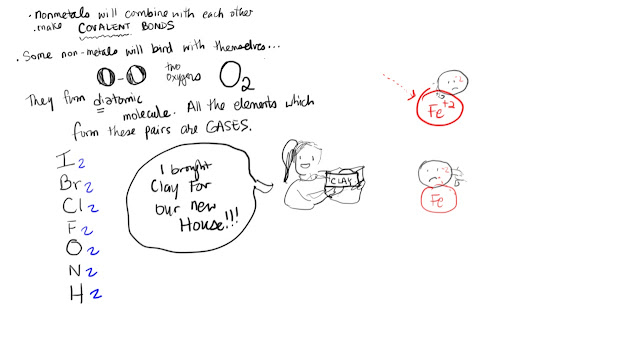
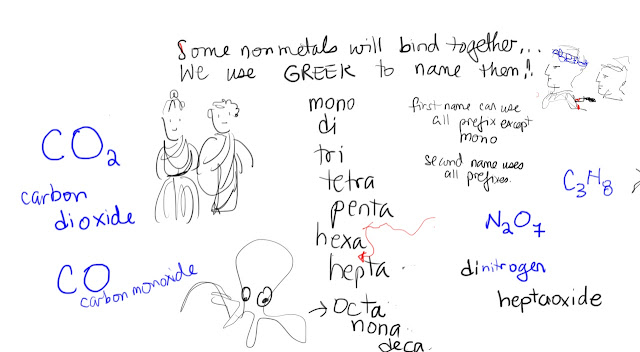
We went over compounds lately monatomic atoms and covalent compounds.

Now we are doing a unit on safety. Please do the reading, the homework and MAKE A POSTER SHOWING ALL THE RULES. SUMMARIZE ALL THE RULES IN 4 OR 5 STATEMENTS
1.    


                                                    WHMIS -  WORKPLACE HAZARDOUS 

                         MATERIALS INFORMATION
                         SYSTEM 

      THESE symbols are on the MSDS sheet for
       all chemicals    Materials safety Data Sheet. 

Follow teacher instructions
a.     If you wish to change instructions, check with teacher
b.     If you break anything or get hurt, report it REPORT ACCIDENTS

2.     No horseplay, fooling around
3.     Keep yourself safe
a.     Hair tied back, no loose clothing, shoes are closed
b.     If chemicals get on skin, use water
c.     Use eyewash if anything gets in eyes
d.     Wear goggles if needed
e.  If you wear contacts, inform the teacher

4.      Keep your area safe
a.     your work area is neat and organized
b.     you have your lab instructions
c.     aware of fire safety and chemical safety

5.     Keep the classroom safe
a.     Carry materials in a safe way
b.     Aware of fire safety procedure
c.     Don’t remove any experiments from the classroom
d.     Don’t do experiments without first checking with teacher.


6.      Hot and cold and chemical safety
a.     never assume the temperature of something.  Take precautions
b.     hot beaker and cold beaker look identical
c.     always point a test tube away from everyone

d.     when smelling a chemical, waft.


You will create safety rules by reading and summarizing the safety procedures in your text.  Then you will take the Finn Laboratory Saftey Test

The rules can be under the following categories:
HIGHEST PRIORITIES:

THESE RULES CAN BE SUMMED UP LIKE THIS
Talk to the instructor                     

KEEP ORGANIZED AND SAFE
Keep the classroom safe
Keeping your work area safe
Keep safe with your colleagues
Keep yourself safe
KNOW THE SYMBOLS
Know the correct symbols, WHIMIS symbols


COMMUNICATE AND REACT TO AN EMERGENCY
       Emergency procedures for fire, toxins, spills, and evacuation  


SAFETY ASSIGNMENT:  I divided you into groups and talked about WHMIS.  Make a poster of the 20 safety rules which I handed out in class. 
Your group must draw a comic showing all the safety rules on one side of the page. put numbers to show where the rule is being applied.   

RUBRIK:  out of 10
YOUR POSTER IS COMPLETE SHOWING ALL 20 RULES      5 marks
   it is missing a few of the rules   2-4 marks

the poster is neat and organized and easy to read    3 marks
      it could be better organized and not so cluttered  1-2 marks

the poster is remarkably artistic and creative and is different in some way   2 marks
    the poster is very well done and artistic 1.5 marks
    the poster is artistic    1 mark


Monday, 11 September 2017

Making Compounds

Quiz for Sept 15

Today I gave you a lecture on Polyatomics.  We practiced identifying by playing a game, stand up if it's a polyatomic, sit down if I say a regular ion.  Next, meow if it is a cation and bark if it is an anion.  We then played the chemistry card game to practice making compounds.


Now that you've had some practice, 
I will give you a list of ions and you will write compounds and formulae


Quiz questions for Sept 13

1.  What is a positive ion called?
2.  What is a negative ion called?
3.  Where are the metals and non metals on the 
periodic table?  Explain
4.  write the names of compounds which I list (5). 


EACH LEGO PIECE IS one ATOM.  

A BOX  of the same kind of atom
 is called   AN ELEMENT. 

TWO OR MORE DIFFERENT LEGO PIECES 
are attached TOGETHER, this is a COMPOUND
Make different compounds out of the lego

hydrogen oxide
sodium fluoride
lithium oxide
magnesium oxide
magnesium chloride
aluminum fluoride
aluminum oxide 

THERE ARE TWO KINDS OF COMPOUND
   1. Ionic compound:  metal with a nonmetal
   2.  Covalent compounds:  nonmetal with a nonmetal

Today we will practice making IONIC COMPOUNDS


to make covalent compounds we follow different rules


Thursday, 7 September 2017

Matter and Energy

Quiz questions:

1.  What are some examples of matter and energy?
Give at least 5 examples of each
2.  What are the phases of matter?

Explain the lego analogy
ONLY 1 AND 2 FOR NEXT PERIOD

3.   Explain the idea of chemical families
on the periodic table
4.  Give some examples of compounds


Notes
1. matter is anything with MASS AND VOLUME
       ex. anything that takes space and can be measured in grams
energy makes matter move
      ex.  LIGHT, SOUND, HEAT, ELECTRICITY,  KINETIC,
RADIATION

POTENTIAL ENERGY SUCH AS ELASTIC, GRAVITATIONAL


Everything in the universe is made of MATTER
OR ENERGY AND the interaction of matter and energy
and some of these factors are

MATTER AND ENERGY ARE ALWAYS QUANTITATIVE DATA.
THEY CAN BE MEASURED
measurable - quantitative data

not easily measurable but must be
described - qualitative data example is love.


Science uses both quantitative and qualitative data

THE PHASES OF MATTER ARE
 SOLID    LIQUID   GAS


THE PERIODIC TABLE IS A LIST OF ALL THE
TYPES OF MATTER IN THE UNIVERSE.

the LEGO ANALOGY: 

All matter in the universe is made of LEGO (atoms) 
There are many types of lego. But each type of lego
is made of the same material, the same kind of plastic.

they differ only in their SIZE, SHAPE, COLOUR.

THE PERIODIC TABLE IS A LIST OF ALL THE
DIFFERENT TYPES OF LEGO

EACH LEGO PIECE IS one ATOM.  

A BOX  of the same kind of atom
is called   AN ELEMENT. 

TWO OR MORE DIFFERENT LEGO PIECES 
are attached TOGETHER, this is a COMPOUND


Make different compounds out of the lego

hydrogen oxide
sodium fluoride
lithium oxide
magnesium oxide
magnesium chloride
aluminum fluoride
aluminum oxide