Wednesday, 6 April 2016

Test next tuesday on 6.1 and 6.2

Today we went over the 6.2 questions.  next period we will finish the questions and review the steps of meiosis.  Next tuesday there is a test on 6.2 as well as steps for meiosis


Monday, 4 April 2016

The evolutionary history of sexual reproduction AND 6.2 vocab

SECTION 6.2
in the last few lessons, we went over all the vocabulary of section 6.2 in the textbook.  You ought to know this vocab for our next test/quiz. I did a HOMEWORK CHECK of

1.VOCAB WORDS COMPLETED
2. LAB DRAWINGS COMPLETED AND LABELED
2.  ALL QUESTIONS FINISHED PAGE 223

For a lab, we observed and made drawings of:
a flower and its reproductive parts
A blastula and gastrula
a preprepared slide from "northwest" laboratories of human sperm


EVOLUTION OF SEXUAL REPRODUCTION
We also went outside to observe the morphology of plants and their parts for sexual reproduction.  Plants engage in external fertilization.  And, early in evolutionary history, plants required water for sexual reproduction. In particular, we observed that the evolution of plants on land occurred in this order:
marine protozoa which photosynthesize (algae) - use egg and sperm as gametes
mosses and other bryophytes - egg and sperm
Ferns - egg and sperm
Horsetails - egg and sperm
Gymnosperms (ex. conifers) - wind pollination
Angiosperms (ex. flowering plants) -wind pollination and vector pollination

Examples include the stellar magnolia (Magnolia stellata) which is one of the first ever vector pollinators

We reflected that animal evolution took a different pathway: animals chose to keep the swimming male gamete, the sperm, and thus, internal fertilization is the usual case for terrestrial animals.  Internal fertilization requires the organisms to meet in space and time.  Thus, animals are characterized by courtship behaviours


Monday, 29 February 2016

Do the Chapter review questions for science 9.

Page 184 to 185.  You will be quizzed on this!

Friday, 19 February 2016

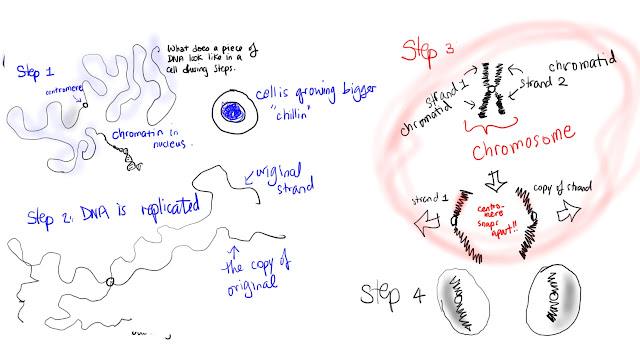
We looked at the steps of mitosis ...Once upon a time there was an Italian Fisherman named "Centriole"


steps of cell cycle:  you should write a table showing the steps as well as the
FORM OF DNA
role of other organelles

1.  INTERPHASE -
a.  cell is undergoing growth.  After a period of growth, it prepares to divide
b.  cell replicates its DNA.  Nuclear membrane is still intact
2. PROPHASE
Nuclear membrane disappears and the chromosomes are visible
3.  METAPHASE
chromosomes line up in the middle and Centrioles send out the spindle fibres to attach to the centromere
4.  ANAPHASE
centromeres get ripped apart and thus the chromosomes get ripped apart into separate chromatids
5.  TELOPHASE
nuclear membrane reforms around the chromatids
6.  CYTOKINESIS
chromatin is in the nucleus now.


Thursday, 11 February 2016

Review of DNA Replication and also the steps for the Cell Cycle and Mitosis p. 150 - 159 in text

Today we reviewed the steps for DNA replication:
1.  Unzip DNA strand with Helicase, which will break the hydrogen bonds
2.  Lay down RNA primer with RNA primase
3. Make the new strand with DNA Polymerase
4.  Repair the phosphodiester links with Ligase.

Today:
We took notes on cell division, cell cycle (four stages), chromatin, chromatid, chromosome 
and diploid number:  Homework, review the vocal words above.


Thursday, 4 February 2016

We made models of DNA and learned about the steps for DNA Replication

You ought to be able to draw the ladder structure of DNA
The two bonds are hydrogen bond and phosphodiester link
Draw a nucleotide and tell me the steps of DNA replication:
1.  Strand unzips with helicase
2.  RNA primase lays down the RNA primer
3.  DNA polymerase builds the new strand in the 5' to 3' direction.  The replication of the lead strand is followed by the lag strand
4.  Ligase fills the gaps on the phospho diester links

Here is the original paper written by Watson and Crick. check it out:  DNA was discovered by Watson and Crick, Franklin and Wilkin.


Tuesday, 26 January 2016

Intro to cell, quiz next day

assignments so far:
CELL ANALOGY PARAGRAPH /5
CARTOON OF PROTEIN SYNTHESIS /5
Questions on p. 130 1-7 and 135, 1-7

I will Quiz you on the homework, randomly selecting 5 questions for you to answer.